TL;DR
- task : long-tail object detection
- problem : COCO 데이터는 long-tail로 annotation 되어있고 그에 맞게 학습하는데 평가 metric인 mAP는 AUC여서 간극이 있음
- idea : mAP를 probabilistic하게 바꾸고 이를 detection에서의 class-margin bounds 하의 pairwise ranking error(=negative sample x’가 positive x 보다 더 높게 rank 되는 frequency를 측정)의 weighted version으로 bound해서 이를 최적화.
- architecture : Mask R-CNN, Cascade Mask R-CNN
- objective : ECM loss
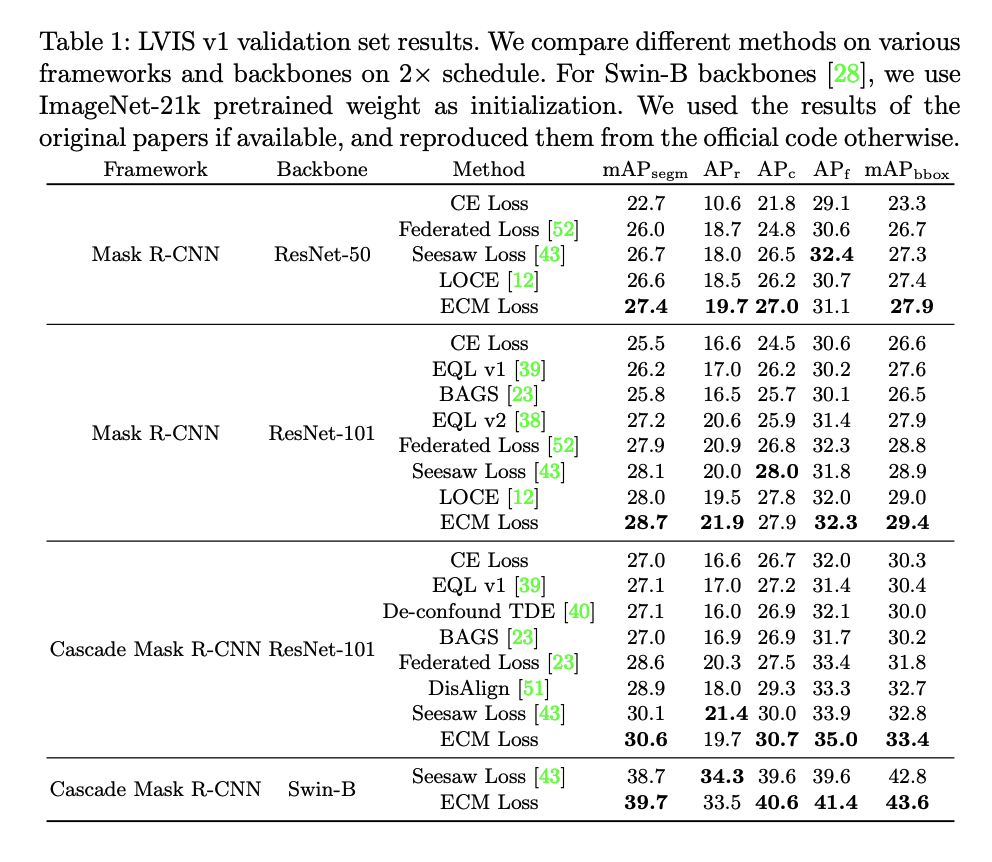
- baseline : CE Loss, Federated Loss, Seesaw Loss, LOCE loss
- data : LVIS v1, Open Images
- result : SOTA
- contribution : no hyper-parameter for long-tail problem
- limitation or 이해 안되는 부분 : 수식식을 다 이해하진 못함. duplicate object에 대한 penalty 효과가 없다고 함. DETR류에는 못 쓰이려나?
Details
related work
Long-tail Detection related work
- 대부분의 선행 연구가 loss를 implicit/explicit 하게 re-weighting하는 접근법.
- Equalization loss : rare class의 negative gradient를 제거하는 방식
- 다른 클래스들의 negative gradient들에 의해 rare한 class가 discourage 된다는 가정
- Balanced Group Softmax(BaGS) : training set에 나온 빈도별로 group을 나누고 거기서 softmax + cross-entropy 구함
- federated loss : 이미지에서 나온 class의 negative gradient만 계산함
- Equalization Loss V2 : 클래스별로 positive / negative의 누적 비율을 맞추려고 함
- SeeSaw loss : rare class의 negative gradient에 대한 weight를 frequency가 높으면 줄여줌
Learning with class-margins
- face-recognition 같은데 많이 쓰인다고 하넹
- Learning Imbalanced Datasets with Label-Distribution-Aware Margin Loss
주요 전개
- preliminary: class-margin bound

그냥 class loss 구하는 것보다 margin으로 class loss 구하는게 더 loss가 작다는 뜻인듯? 이 수식은 다른 페이퍼에서 증명됨
- Decision Metrics : mAP

이를 probabilistic하게 바꾸면 아래와 같이 바꿀 수 있음

이는 class margin bound를 가진 weighted pair-wise ranking error로 bound될 수 있음

이때 pair-wise ranking error는 negative sample x’가 positive sample x보다 더 높게 rank 되는 frequency
여기서 ranking loss는 또 threshold를 추가한 binary error로 bound될 수 있음

이 식을 어떻게 정리하다보면.. 위의 class-margin bound와 함께 결합하면 가장 tight한 margin을 구할 수 있음

이를 다시 정리하면, 우리는 margin-based error를 최소화 하고 싶은데 이는 threshold가 0.5가 아닌 margin이 되는 sigmoid를 적용하는 것이고

- 여기서 $m_c$는 ranking error를 bounding 하기 위한 값인데 역시 이도 bound로 표현됨

이때 score function은 가장 tight한 margin으로 weighted sum된 형태임

Results